 blog
Grooming Services for Senior Cats with Arthritis
Last Updated: November 1, 2026
Quick Summary
Grooming services for senior cats with arthritis adapt handling to the cat's range of motion, using padded surfaces, short working bursts, and breaks instead of full-body flips or scruffing. Sessions usually run every four to six weeks, with daily two-minute brushing at home between visits to prevent mats.
- Arthritis shows up as hesitation before jumping, shorter strides, and stiffness after naps rather than obvious limping.
- Mats along the lower back and hindquarters signal the cat can no longer twist to groom there.
- Work in five-minute bursts with breaks, brushing with the coat and never against it.
- Short-haired seniors often do well every six to eight weeks; long-haired cats closer to every four weeks.
- Tell the groomer about your cat's arthritis and sensitive spots when you book, not when you arrive.
Table of Contents
- Why Senior Cat Grooming Changes When Arthritis Sets In
- Signs of Arthritis in Senior Cats Every Owner Should Recognize
- How Professional Grooming Helps a Cat With Mobility Issues
- Gentle Cat Grooming Techniques Built for Stiff Joints
- Cat Grooming Frequency for Seniors: Finding the Right Rhythm
- Comparing Grooming Options for a Senior Cat With Arthritis
- What to Look for in a Groomer for an Elderly Cat
- Booking a Comfort-First Grooming Visit for Your Senior Cat
- Frequently Asked Questions
Why Senior Cat Grooming Changes When Arthritis Sets In
Grooming services for senior cats with arthritis look nothing like a standard cat groom. Arthritis is a degenerative joint disease that can change how a cat tolerates being handled, positioned, and brushed. A cat that once stretched out for a full-body comb may now guard a stiff hip or shoulder, and that guarding changes what a groomer can safely do in one session.
The coat often tells the story before the cat does: missed spots along the spine, small mats behind the shoulders, a dull patch where the cat can no longer reach. None of that is a grooming failure. It's a mobility signal.
Here's what most owners get wrong: they wait for visible mats before booking. By then, the skin underneath may already be irritated, and the cat's pain response is higher. Early, gentle maintenance beats a rescue groom every time.
Cornell Feline Health Center on arthritis in cats
Signs of Arthritis in Senior Cats Every Owner Should Recognize
Arthritis in senior cats shows up first as small changes in movement and grooming habits, not dramatic limping. Owners who know what to watch for can notice it earlier.
Mobility Clues You Can Spot at Home
Watch how your cat gets from point A to point B.
- Hesitation before jumping onto a favorite chair or windowsill
- Shorter strides, or a stiff, bunny-hop gait in the back legs
- Reluctance to use stairs or climb into a high-sided litter box
- Sleeping in new, lower spots instead of the usual perch
- Stiffness after a long nap that eases once the cat moves around
A cat that stops jumping isn't being lazy. It's making a calculation about pain.
Coat and Skin Signals That Point to Pain
The coat is a map of where your cat can still reach. Mats concentrated along the lower back and hindquarters usually mean the cat can't twist to groom there anymore. Greasy or flaky patches near the tail base, dandruff along the spine, and a sudden reluctance to be brushed on one side all point the same direction.
Watch out: if your cat flinches, hisses, or swats when you touch a specific joint, stop and let a veterinarian assess it. That reaction is pain, not attitude.
How Professional Grooming Helps a Cat With Mobility Issues
Professional grooming helps a cat with mobility issues by taking over the parts of self-care the cat can no longer manage, without forcing the cat into positions that hurt. The groomer works with the cat's range of motion instead of against it.
For a senior cat, that means shorter sessions, padded surfaces, and a handler who reads body language before restraints. A cat that can't lift its hind leg for cleaning gets targeted help around the sanitary area. A cat that can't reach its back gets gentle de-matting rather than a full shave-down.
The benefits go beyond appearance, since removing mats and cleaning areas the cat cannot reach help keep the skin in better condition.
Gentle Cat Grooming Techniques Built for Stiff Joints
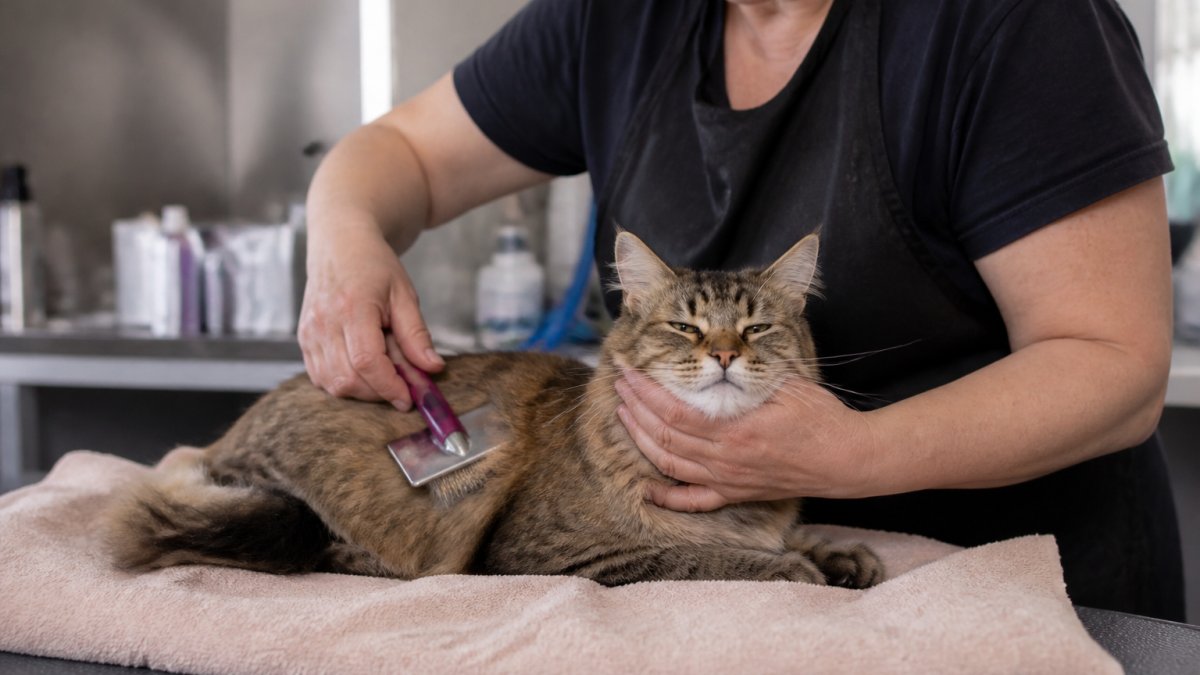
Gentle cat grooming for stiff joints can prioritize support and short working bursts, without forcing extension of the joints. The goal is a calm cat and a clean coat.
Handling, Restraint, and Positioning That Reduce Strain
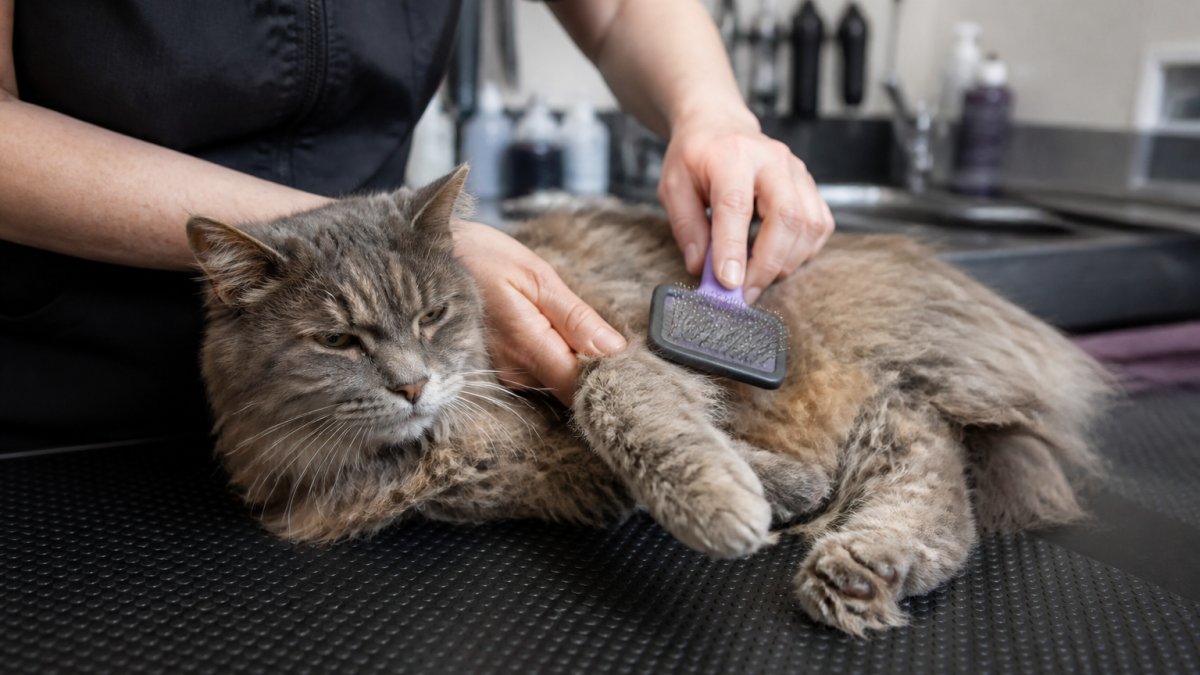
Start with a non-slip mat and a rolled towel under the chest or hips. That small bit of padding takes weight off the joints and keeps the cat from bracing.
Work in five-minute bursts with breaks. Brush with the coat, never against it. Use a soft slicker on the areas the cat can still reach and a wide-tooth comb on the tender spots. Skip the full-body flip. A cat with arthritis should never be scruffed or stretched.
Cat Grooming Frequency for Seniors: Finding the Right Rhythm
Cat grooming frequency for seniors usually lands every four to six weeks, but the right rhythm depends on coat type and how much self-grooming the cat has lost. Short-haired seniors often do well every six to eight weeks. Long-haired cats and cats with heavy undercoat need closer to every four weeks.
The better question is what happens between appointments. Daily two-minute brushing sessions on the spots your cat can still tolerate keep mats from forming in the first place. If you find a mat, don't cut it out with scissors. Cat skin is thin and loose, and scissor cuts are a common home-grooming injury.
Watch out: a sudden drop in grooming behavior, or a coat that goes from tidy to matted in a few weeks, is worth a vet call. It can signal pain elsewhere.
Comparing Grooming Options for a Senior Cat With Arthritis
Not every grooming setting suits an arthritic cat, and the differences matter more than the label on the door. Here's how the common options compare for a senior cat with joint pain.
| Option | Handling Approach | Session Length | Best For |
|---|---|---|---|
| Full-service salon, by appointment | One-on-one, padded table, breaks as needed | Flexible, often shorter | Cats with moderate arthritis who tolerate handling |
| Mobile grooming van | One pet at a time, familiar driveway setting | Fixed slot | Cats stressed by car travel |
| Big-box retail grooming | High volume, multiple pets nearby | Fixed slot | Young, healthy cats with no mobility limits |
| Home grooming by owner | Full control of pace | As long as needed | Light maintenance between professional visits |
| Veterinary grooming | Medical oversight on site | Varies | Cats with severe pain or skin conditions |
The pattern is clear: the more one-on-one attention a setting allows, the better it fits a cat that can't be rushed. High-volume environments move fast because they have to, and a stiff cat can't keep up.
What to Look for in a Groomer for an Elderly Cat
Look for a groomer who asks about your cat's health before the appointment and adjusts the plan around it. That single habit separates a groomer who understands senior cats from one who treats every cat the same.
Ask these questions before you book:
- Do you groom cats regularly, or mostly dogs?
- How do you handle a cat that can't stand for long periods?
- Will you work in short bursts and let the cat rest?
- What's your policy if the cat becomes distressed?
- Can I stay nearby during the appointment?
A groomer who welcomes those questions is usually the one who will handle your cat with care.
AAHA senior care guidelines for dogs and cats
Booking a Comfort-First Grooming Visit for Your Senior Cat
Book a comfort-first visit by telling the groomer about your cat's arthritis, sensitive spots, and stress triggers when you schedule, not when you arrive. That conversation shapes everything from session length to how the cat is positioned.
At STEPH'S CUTE CRITTER CUTS & CORI'S CRITTER CREATIONS, we groom by appointment only at our Deltona and Orange City locations. We offer full grooms and baths, and we provide personalized attention for every pet.
ASPCA on caring for senior cats
Ready to schedule? Visit STEPH'S CUTE CRITTER CUTS & CORI'S CRITTER CREATIONS to book your senior cat's grooming visit. Book a visit that puts your cat's comfort first.
Senior cats with arthritis need grooming that accounts for their limits. If your cat has stiff joints, sensitive skin, or a coat that's starting to slip out of reach, we can help. At STEPH'S CUTE CRITTER CUTS & CORI'S CRITTER CREATIONS, we offer by-appointment grooming at two convenient locations, personalized attention for every pet, and personalized attention for every pet. Get started with STEPH'S CUTE CRITTER CUTS & CORI'S CRITTER CREATIONS and give your senior cat a grooming experience that respects every joint.
Frequently Asked Questions
How do you groom a cat that is in pain from arthritis?
Start with a veterinary check so pain is managed before any grooming session. At home or in a shop, keep sessions short, use a soft brush on small sections, and support the cat's chest and hindquarters instead of lifting by the scruff. Skip matted areas that sit over sore joints and work around them. Watch for flattened ears, tail flicking, or sudden stillness, and stop the moment you see them. A groomer experienced with senior cats will work in short bursts, often with breaks, rather than pushing through a full groom in one pass.
Can professional grooming help a senior cat with mobility issues?
Yes, mainly because a stiff cat cannot reach its back, hindquarters, or tail base to self-groom. That leads to mats, dander buildup, and skin irritation. Grooming can help remove tangles and clean areas the cat cannot reach. The visit also gives you a second set of eyes on coat and skin changes. For senior cat grooming, the goal is comfort and hygiene, not a full show-style cut, so ask for a maintenance groom rather than a complete restyle.
What should I look for in a groomer for an elderly cat?
Ask three things before booking. First, whether they groom senior cats regularly and how they handle arthritic joints. Second, whether they work by appointment so the shop stays calm rather than a busy walk-in queue. Third, whether they will stop a session early if the cat is stressed. Look for a groomer who asks about your cat's health conditions and medications up front. Photos and reviews from owners of older pets can be a useful signal when comparing options.
How often should a senior cat with arthritis be groomed?
Cat grooming frequency for seniors usually lands every four to six weeks for a professional visit, with short brushing sessions at home two or three times a week in between. Cats with heavy coats, matting, or limited mobility may need closer to every three to four weeks. Cats that still self-groom well can stretch to every six to eight weeks. Your vet and groomer can adjust the schedule based on coat condition, skin health, and how the cat handles handling. Consistency matters more than a strict calendar.