 how-to
7 Calming Steps for Stress Free Dog Grooming for Nervous Pets
Last Updated: November 5, 2026
Quick Summary
Stress free dog grooming for nervous pets works by pairing scary tools with treats, one small step at a time, and stopping before fear takes over. Practice handling at home in sessions under five minutes, and expect weeks rather than days for real progress.
- Exercise your dog two to three hours before the appointment and skip a heavy meal right before.
- Run one desensitization stage at a time, two to four short sessions per day, each under five minutes.
- A mildly nervous dog often moves through the stages in four to six weeks.
- If your dog stops eating treats mid-session, that is a stress signal, so end the session.
- Ask groomers whether they use minimal restraint, take breaks, and stop if your dog is overwhelmed.
Table of Contents
- Why Nervous Dog Grooming Goes Wrong (and What Changes It)
- How to Calm a Dog Before Grooming: The Pre-Visit Routine
- Preparing a Nervous Dog for Grooming: What to Do at Home
- Dog Grooming Desensitization: A Staged Plan That Works
- Signs of Stress in Dogs During Grooming: A Body-Language Checklist
- Choosing a Groomer Who Handles Fearful Dogs Well
- Adapting the Plan for Age, Health, Coat, and Past Trauma
- Booking Your Nervous Pet's First Calm Grooming Visit
- Frequently Asked Questions
Why Nervous Dog Grooming Goes Wrong (and What Changes It)
Stress free dog grooming for nervous pets starts with one truth: most grooming anxiety is learned, not permanent. The difference is rarely the dog's personality. It's the approach.
The old way fails because it treats fear as a behavior problem to push through. A scared dog gets rushed, restrained, and finished fast. That works for the schedule. It teaches the dog that grooming is a threat.
What changes things is a slower, kinder method: reduce the trigger, build trust over visits, and stop before fear takes over. It takes planning.
The Triggers Behind Grooming Anxiety
Dogs fear grooming for clear reasons. Loud clippers hum near their ears. Strangers touch sensitive spots. Other dogs bark nearby. The table feels unsteady under their paws.
A common mistake is assuming the dog hates the bath. Often it's the dryer, the nail trim, or simply being lifted onto a table. Watch what happens right before your dog panics. That moment names the real trigger.
How to Calm a Dog Before Grooming: The Pre-Visit Routine
The best time to calm a nervous dog is hours before the appointment, not minutes. A tired dog handles stress better than a wired one. Build a simple routine the day of the visit.
- Take a long walk or play session two to three hours ahead
- Skip a heavy meal right before the appointment
- Let your dog relieve itself before leaving home
- Bring a favorite toy or blanket with a familiar smell
- Stay relaxed yourself; dogs read your tension
Exercise, Timing, and the Calm Car Ride
A tired dog settles faster. Aim for solid exercise, but give your dog time to rest before the car ride. Arriving out of breath and overstimulated backfires.
In the car, keep the crate or seatbelt secure and the temperature cool. Play soft music. Skip the drive-through errands on the way. A calm, direct ride sets the tone for the whole visit.
Preparing a Nervous Dog for Grooming: What to Do at Home
Preparing a nervous dog for grooming means practicing the handling at home, long before the appointment. Touch your dog's paws, ears, and muzzle for a few seconds each day. Pair every touch with a treat. Keep sessions short and end on a good note.
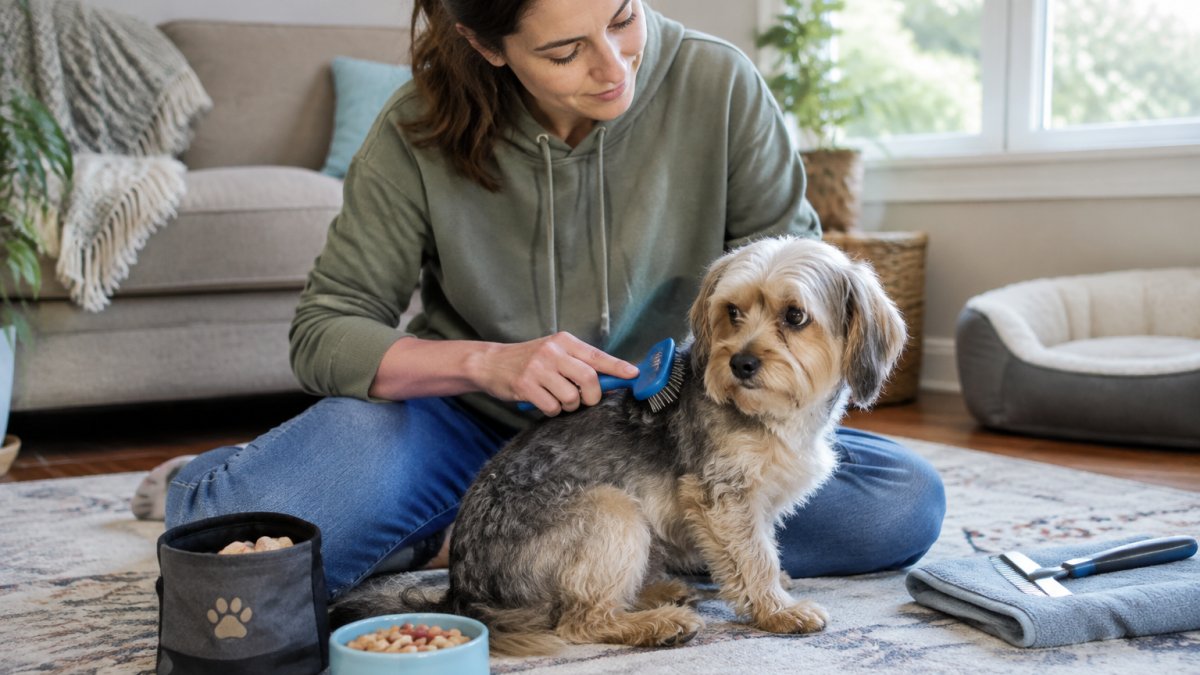
Run the clippers nearby while they're off, then on, without touching your dog. Let the sound become background noise. Brush for a minute, then stop. This is how trust building starts at home.
Watch out: if your dog snaps or freezes during home practice, back up a step. Pushing through a hard no teaches your dog that handling predicts bad things.
Dog Grooming Desensitization: A Staged Plan That Works
Dog grooming desensitization works by pairing scary tools with good things, a process called counterconditioning. You expose your dog to one small trigger at a time, always below the level that causes fear, then add a treat or praise.
Below is a staged plan you can work through at home, with session lengths and advancement criteria. Run one stage at a time, two to four short sessions per day, and keep each session under five minutes. End every session while your dog is still relaxed and still eating treats.
- Stage 1, Handling (paws, ears, muzzle). Touch one area for two to three seconds, then treat. Repeat five to eight times per session. Move to Stage 2 when your dog leans in or stays relaxed for ten consecutive touches without pulling away.
- Stage 2, Tool sounds (clippers off, then on, across the room). Turn the clippers on for three seconds at the far side of the room, treat, turn off. Work closer over several sessions. Move on when your dog eats treats and stays settled with the clippers running two feet away.
- Stage 3, Tool contact (clippers off against the body, then brush). Rest the clippers (off) against the shoulder for two seconds, treat. Then brush one stroke, treat, one stroke, treat. Move on when your dog accepts ten brush strokes in a row without freezing or pulling away.
- Stage 4, Nail handling. Hold one paw for two seconds, treat, release. Add the nail trimmer near the paw without clipping, then one nail per session. Move on when your dog allows all four paws handled and one nail trimmed calmly.
- Stage 5, Mini sessions between professional visits. Practice one or two stages per week at home so the progress holds between appointments.
A Realistic Timeline for Gradual Exposure
Expect weeks, not days. A mildly nervous dog often moves through the stages in four to six weeks. A dog with a bite history or severe fear may need several months and a slower pace. That is normal, and it is progress.
A common pattern is that dogs plateau at Stage 2 or Stage 4. If your dog stalls for more than three sessions, drop back one stage for a week, shorten sessions, and use higher-value treats. Gradual exposure done right beats one forced session every time.
Watch out: if your dog stops eating treats mid-session, that is a stress signal, not stubbornness. End the session and try again at a lower intensity the next day.
Here is the staged plan at a glance, with what to do at each step and when to move on.
| Stage | What to do | Move on when |
|---|---|---|
| Stage 1, Handling | Touch paws, ears, muzzle for two to three seconds, then treat | Relaxed for ten consecutive touches |
| Stage 2, Tool sounds | Clippers on for three seconds across the room, treat, off | Settled with clippers running two feet away |
| Stage 3, Tool contact | Clippers off against shoulder, then one brush stroke, treat | Accepts ten brush strokes without freezing |
| Stage 4, Nail handling | Hold one paw two seconds, treat, add trimmer, one nail per session | All four paws handled and one nail trimmed calmly |
| Stage 5, Mini sessions | Practice one or two stages per week between professional visits | Progress holds between appointments |
Signs of Stress in Dogs During Grooming: A Body-Language Checklist
Signs of stress in dogs during grooming are easy to miss if you don't know what to watch for. Catch these early and you can adjust before fear escalates. The key is to read signals in tiers, because a single lip lick means something different from a stiff body and a hard stare.
Tier 1, Early signals (pause and slow down):
- Lip licking or yawning when nothing else explains it
- Ears pinned back or turned away
- Whale eye (whites of the eyes showing)
- Tail tucked tight against the body
- Turning the head away from the tool or handler
Tier 2, Escalating signals (stop the current step and give a break):
- Trembling, panting, or drooling when the room is not hot
- Freezing in place or trying to climb away
- Sudden stillness with a hard stare
- Repeated paw lifts or attempts to jump off the table
Tier 3, Stop signals (end the session):
- Growling, snapping, or stiff body posture
- Air-snapping or muzzle-punching toward the handler
- Trying to bite or bolt
A dog showing several Tier 1 signals needs a slower pace, not more pressure. A dog showing Tier 2 signals needs a break and a reassessment of whether the step is too much. A dog showing Tier 3 signals needs the session to stop, full stop. Gentle handling and minimal restraint keep stress low, and stopping early protects the trust you have built.
Watch out: a dog that goes completely still and stops reacting is not necessarily calm. Freezing is often the last warning before a snap, so treat sudden stillness as a stop signal, not a green light.
Choosing a Groomer Who Handles Fearful Dogs Well
The right groomer changes everything for a fearful dog. Ask direct questions before you book. A good low-stress groomer welcomes them.
- How do you handle a nervous or reactive dog?
- Can you do shorter visits to build trust first?
- Do you use minimal restraint and take breaks?
- Will you stop if my dog is overwhelmed?
Look for a calm, quiet environment with fewer dogs at once. Ask about one-on-one attention. Our team focuses on personalized care for exactly this reason, and you can see how we approach anxious and difficult dogs before your first visit. It also helps to know what to ask a professional groomer and why personalized care beats one-size-fits-all grooming.
Adapting the Plan for Age, Health, Coat, and Past Trauma
No two nervous dogs need the same plan. A senior dog with arthritis needs gentle handling and soft bedding, not long stand times. A thick-coated doodle needs more frequent brushing at home to prevent mats that make grooming painful.
Puppies benefit from early, positive first visits, and you can read our complete first-grooming guide for a step-by-step start. A rescue dog with past trauma may need extra patience and a slower timeline. Tell your groomer about health issues, sensitive skin, or old injuries up front. Safety comes first, and a good groomer will adjust the pace to match your pet.
Booking Your Nervous Pet's First Calm Grooming Visit
A calm first visit sets the pattern for every visit after. Book a short appointment, arrive early, and let your dog settle in the space. Skip the rush. Skip the crowd.
At STEPH'S CUTE CRITTER CUTS & CORI'S CRITTER CREATIONS, we offer two convenient locations, by-appointment scheduling for personalized care, and full grooms and baths.
Ready to book your pet's grooming visit? Book your pet's grooming visit with us today.
Frequently Asked Questions
How do groomers deal with anxious dogs?
A groomer who handles nervous dog grooming well works at the dog's pace. That means gentle handling with minimal restraint, a quiet environment away from barking, short breaks when stress signals appear, and positive reinforcement with treats and praise. Many also use calming aids like pheromone spray. Ask any groomer directly how they handle a fearful dog before you book, and look for one who invites a meet-and-greet first.
Can a nervous dog get used to being groomed?
Yes. Dog grooming desensitization works through gradual exposure and counterconditioning: short, low-pressure sessions with clippers, brushes, and handling, each paired with treats and praise. Progress is measured over repeated visits, not one appointment. Some dogs settle in a few weeks; dogs with prior trauma or health sensitivities take longer. The key is consistency and never forcing a step the dog is not ready for.
What are signs that a dog is too stressed during grooming?
Watch for stress signals in dogs during grooming: tucked tail, flattened ears, lip licking, yawning, whale eye (showing the whites), trembling, panting without heat, freezing, growling, or snapping. Mild signals mean slow down and add breaks. Repeated growling, attempts to escape, or snapping mean the session should stop. A good groomer will pause and tell you, not push through.
What should I tell a groomer about my dog's anxiety?
Be specific. Tell them what triggers your dog (clippers, nail trimming, bathing, other dogs), what stress signals you see first, what calms them (treats, praise, breaks, a favorite toy), and any health or age issues. Mention prior bad experiences. This lets the groomer plan gentle handling and minimal restraint from the start. Preparing a nervous dog for grooming is a team effort between you and the groomer.