 how-to
How Do You Groom a Nervous Senior Cat Without Stress?
Last Updated: November 4, 2026
Quick Summary
To groom a nervous senior cat without stress, make sessions predictable, short, and tied to treats, building up over several weeks of low-pressure stages. Start with room and tool acclimation, then one-stroke brushing, and cap sessions at five minutes. Stop at the first stress signal and never push through.
- A nervous senior cat often needs several weeks of short, low-pressure sessions before a full side can be brushed.
- Cap grooming sessions at five minutes, since a calm five-minute session beats a tense fifteen-minute one.
- Stop at the first stress sign, such as flattened ears, wide pupils, or skin rippling along the back.
- Support the body, never the scruff, and let the cat stay on the floor if it resists being lifted.
- Never cut a mat with scissors, because senior skin is thin and a slip is easy.
Table of Contents
- Why Senior Cats Need a Gentler Grooming Approach
- How to Calm a Nervous Cat for Grooming: A Step-by-Step Plan
- Best Grooming Tools for Senior Cats With Sensitive Skin
- Safe Handling and Body Positioning for Cats With Mobility Limits
- Tackling Mats and Tangles: What You Can Safely Do at Home
- Signs a Senior Cat Needs Professional Grooming
- Senior Cat Grooming Frequency: Building a Routine That Sticks
- Booking a Calm, Senior-Friendly Grooming Appointment
- Frequently Asked Questions
Why Senior Cats Need a Gentler Grooming Approach
Learning how to groom a nervous senior cat starts with one shift in thinking: an older cat's body and mind work differently than they did at two years old. Cats that once tolerated a full brush-down can start to flinch at the first stroke.
Senior cat grooming is the practice of adjusting coat care, handling, and session length to match an older cat's lower mobility, thinner skin, and reduced tolerance for stress. It is not about doing less. It is about doing it differently.
Aging changes the rules. Joints stiffen, so reaching the back and tail becomes hard. Skin gets thinner and easier to nick.
How Self-Grooming Changes With Age
Cats are built to keep themselves clean. A healthy young cat spends hours a day on it. Age erodes that routine in predictable ways:
- Stiff joints make it painful to twist toward the lower back and hindquarters
- Dental problems turn licking into an uncomfortable chore
- Thinner skin makes over-grooming irritating
The result is a coat that slowly loses its shine and develops tangles in the spots the cat can no longer reach. Those tangles become mats, which pull on skin and trap moisture.
For a broader look at the age-related changes behind this, our guide to grooming tips for senior cats walks through coat, skin, and behavior shifts in more detail.
How to Calm a Nervous Cat for Grooming: A Step-by-Step Plan
The best way to calm a nervous cat is to make grooming predictable, short, and tied to something pleasant. Fear fades when nothing surprising happens, but only if you stage it like a training plan rather than a single appointment.
A nervous senior cat often needs several weeks of short, low-pressure sessions before a full side can be brushed without tension. Move to the next stage only when the cat stays relaxed through the current one.
Stage 1: Room and Tool Acclimation (Days 1-3)
- Pick one quiet room. Choose a space with no foot traffic, no other pets, and soft light. Close the door.
- Set the tools out first. Have your brush, treats, and a towel within reach before the cat enters.
- Let the cat settle. Sit on the floor and ignore the cat for a minute. Let it sniff the tools on its own terms.
- Reward curiosity, not compliance. Drop a treat near the brush each time the cat approaches it. End after two or three minutes, whether or not the cat touched anything.
Stage 2: Touch Without Tools (Days 4-7)
- Pair touch with treats. Touch a shoulder, then treat. Touch a paw, then treat. Touch the chin, then treat. Keep each touch to one second.
- Work toward the hard spots slowly. Add the lower back, tail base, and hind legs only after the cat accepts shoulder, chin, and paw touches without flinching.
- End on a calm note. Stop while the cat is still leaning in, not after it pulls away.
Stage 3: One-Stroke Brushing (Days 8-14)
- Start with one stroke. Brush a single pass along the shoulder, then stop and offer a treat.
- Build up over days. Add one or two strokes per session. End every session while the cat is still calm.
- Introduce the comb only after the brush is accepted. A wide-tooth comb on the easy areas comes next, then the brush on the back and tail.
Stage 4: Full Short Sessions (Weeks 3-4)
- Work up to the hard spots. Only brush the back, belly, and tail once the cat accepts the easy areas without tension.
- Cap sessions at five minutes. A calm five-minute session beats a tense fifteen-minute one every time.
The mistake most owners make is pushing for a full groom on day one. That teaches the cat that grooming means being held down. Slow wins.
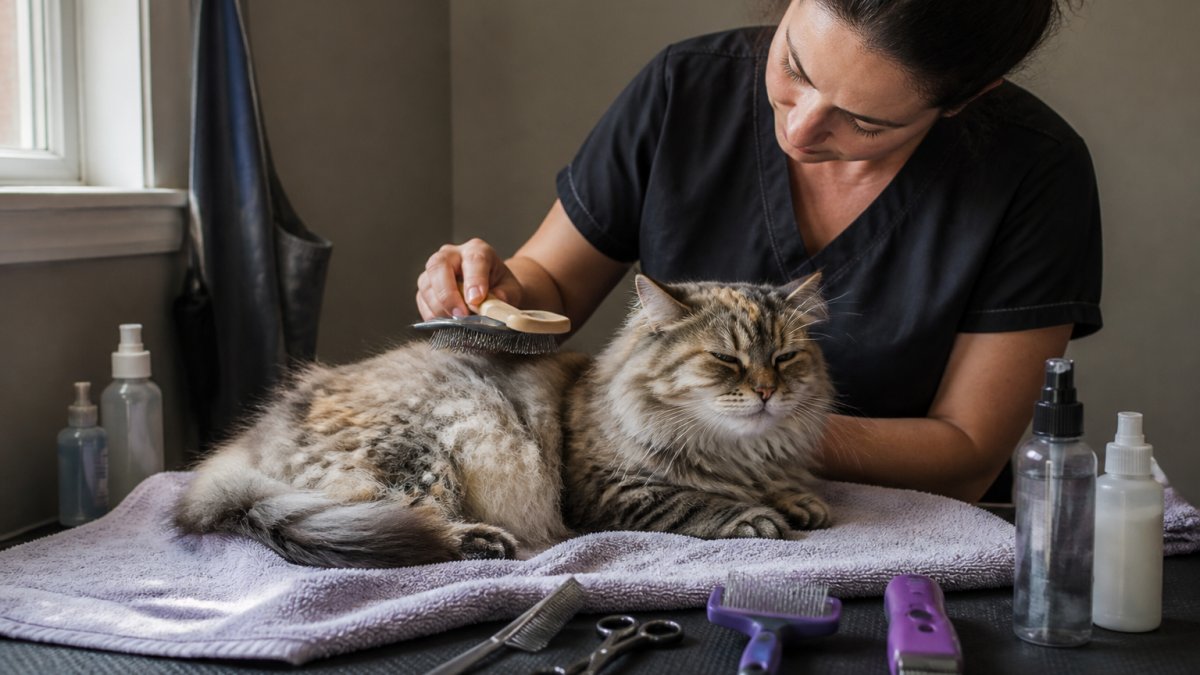
Reading Stress Signals Before They Escalate
A nervous cat tells you it is uncomfortable long before it swats. Watch for these early signs:
- Ears flattening or rotating back
- Tail twitching or wrapping tight
- Pupils wide in normal light
Stop at the first sign. One calm minute now saves a ruined week of trust.
The Stop-and-Reset Protocol
When a cat crosses from uneasy into distressed, do not push through. Use this sequence:
- Stop all contact immediately. Put the tool down and remove your hands.
- Give space. Step back and let the cat move away on its own. Do not pick it up.
- Lower the environment. Dim the light if possible, stop talking, and wait 60 seconds.
- Offer a treat on the floor, not from your hand. A cat that will eat is usually coming back down.
- End the session. Even if the cat relaxes again, do not restart grooming that day. A short positive ending protects the next session.
- Reset the next day at an easier stage. Drop back one stage in the plan and rebuild from there.
Watch out: A cat that hisses, swats, or tries to bite when you touch a specific area is not just nervous. Sudden resistance to grooming, especially in one spot, can signal arthritis, dental disease, or skin problems.
If your cat's anxiety runs high, our practical guide to handling difficult pets during grooming covers calming techniques worth reading before you start the plan above.
Best Grooming Tools for Senior Cats With Sensitive Skin
The right tools for a senior cat are soft, small, and easy to control. Skip anything with sharp teeth or stiff wire.
| Tool | Best For | Why It Suits a Senior Cat |
|---|---|---|
| Rubber curry brush | Short coats, loose fur | Soft tips, no scratching |
| Soft pin brush | Medium and long coats | Gentle detangling on the surface |
| Wide-tooth comb | Checking for tangles | Glides through without pulling |
| Grooming gloves | Cats that fear brushes | Feels like petting |
| Damp microfiber towel | Spot cleaning | No water stress, no shampoo |
A few rules we give every owner:
- Test on your own forearm first. If it scratches you, it will scratch thin senior skin.
- Use cat-safe products only. Never use dog shampoo or human shampoo on a cat.
- Keep a damp towel handy. It lifts loose fur and surface dirt without a full bath.
Safe Handling and Body Positioning for Cats With Mobility Limits
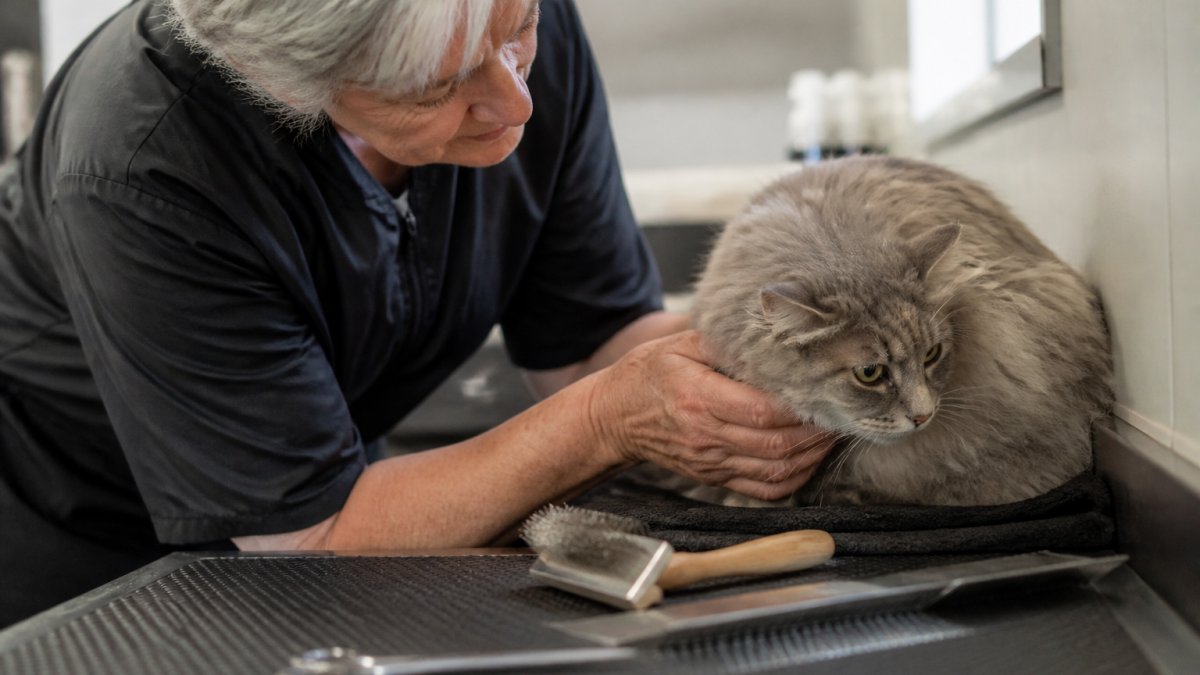
Support the body, never the scruff. That single rule prevents most grooming injuries in older cats. For a nervous cat with stiff joints, positioning is also a desensitization problem: the cat has to learn that being handled does not hurt before any brush touches the coat.
Build Handling Tolerance Before You Groom
Handling can be practiced separately from brushing, which many owners find helps a senior cat with mobility limits settle into grooming. Practice these holds for a few seconds at a time, with a treat after each, on days you are not grooming:
- Chest cradle. Slide one hand under the chest with fingers between the front legs. Hold for two seconds, treat, release.
- Hindquarter support. Slide the other hand under the belly just in front of the back legs. Hold for two seconds, treat, release.
- Combined lift. Only after both holds are accepted, lift the cat an inch off the floor for one second, then set it down and treat.
Stop at the first sign of tension. A cat that stiffens, flattens its ears, or tries to walk away is telling you the hold is not yet comfortable.
Positioning Rules for Stiff Joints and Arthritis
Here is how we position a cat with stiff joints or arthritis:
- Let the cat stay on the floor. Avoid lifting onto a table if the cat resists. A stable, non-slip surface at floor level is safer than a raised table for a cat with balance changes.
- Cradle the chest and hindquarters together. Never let the back legs dangle.
- Work with gravity. Brush downward along the coat, not against it.
Pain Versus Fear: How to Tell the Difference
Fear and pain look similar but call for different responses. Fear usually shows up before you touch the cat: wide pupils, flattened ears, a tight tail. Pain usually shows up when you touch a specific spot: a sudden hiss at the hips, a flinch near the spine, or a cat that stops grooming one area entirely.
Mat Severity: What You Can Safely Do at Home
Safe at home:
- Surface tangles you can see through
- Loose fur clumps on the outer coat
- Small knots you can work apart with fingers and a wide-tooth comb
Leave to a professional or vet:
- Mats pressed flat against the skin
- Mats that pull the skin up when you lift them
- Any mat with red, irritated, or broken skin underneath
Work a tangle loose slowly. Hold the base of the fur near the skin so you never pull the skin itself. Use your fingers first, then a wide-tooth comb. Never cut a mat with scissors. Senior skin is thin, and a slip is easy.
Tackling Mats and Tangles: What You Can Safely Do at Home
Safe at home:
- Surface tangles you can see through
- Loose fur clumps on the outer coat
- Small knots you can work apart with fingers and a wide-tooth comb
Leave to a professional or vet:
- Mats pressed flat against the skin
- Mats that pull the skin up when you lift them
- Any mat with red, irritated, or broken skin underneath
Work a tangle loose slowly. Hold the base of the fur near the skin so you never pull the skin itself. Use your fingers first, then a wide-tooth comb. Never cut a mat with scissors.
If your cat has a long coat and a stubborn mat, our detailed guide on grooming a long-haired cat without stress or mats walks through low-stress dematting technique.
Signs a Senior Cat Needs Professional Grooming
Some situations call for a trained hand. Watch for these signs that a professional groomer or veterinarian should step in:
- Mats that reach the skin or cover a large area
- A coat that has stopped shedding normally
- Greasy, flaky, or irritated skin
For cats with health issues, a vet visit first is the safer order.
Senior Cat Grooming Frequency: Building a Routine That Sticks
Short and often beats long and rare. That is the rule for senior cat grooming frequency.
Aim for a few minutes of brushing most days, or every other day, depending on coat length.
Build the habit around a fixed cue: after breakfast, before bed, or whenever the house is quiet.
Keep a simple log:
- Date and time of session
- Areas brushed
- Any tangles found
That log tells you quickly whether the routine is working or something new is bothering your cat.
Booking a Calm, Senior-Friendly Grooming Appointment
When home care is not enough, a calm, senior-friendly appointment makes the difference. We schedule by appointment only, so every pet receives personalized attention in a welcoming environment.
Our two convenient locations serve pet owners in Deltona and Orange City. To see our full range of baths, full grooms, and extra services, visit our grooming services page and book a time that fits your schedule.
Frequently Asked Questions
Do elderly cats stop grooming themselves?
Many do, or they groom less thoroughly as they age. Arthritis, dental pain, weight changes, and reduced flexibility make it hard for a senior cat to reach the back, tail base, and hind legs. The result is loose fur, dandruff, and mats that build up quietly. If your older cat suddenly stops grooming or grooms only one area, mention it to your veterinarian, since a change in grooming habits can also signal pain or illness.
What are the signs a senior cat needs professional grooming?
Book professional help when you find tight mats close to the skin, greasy or flaky coat patches your cat will not let you touch, soiled fur around the rear, or overgrown nails. Sudden resistance to being brushed, flinching when handled, or hiding after home sessions are also signs a nervous senior cat may do better with an experienced groomer who works at a slower pace in a quiet setting.
How often should I groom a nervous senior cat?
Short, frequent sessions beat long ones. For most older cats, two to three five-minute brushing sessions per week keep the coat manageable, while long-haired cats may need daily touch-ups. Build senior cat grooming frequency around your cat's tolerance, not a calendar. A predictable schedule, always at the same time and in the same quiet room, helps a nervous cat learn what to expect and settle faster.
How do I calm a nervous cat for grooming without stressing it out?
Start in a quiet room with no other pets, use slow movements and a soft voice, and keep each session under five minutes. Brush one small area, then stop and reward with a treat or praise. If your cat shows stress signals like flattened ears, a twitching tail, or dilated pupils, end the session calmly. For cats that stay fearful, ask your veterinarian about calming support before the next appointment.
Grooming a nervous senior cat takes patience, the right tools, and a plan built around trust rather than force. If home sessions keep ending in stress, or if mats and skin issues are piling up, we can help. At STEPH’S CUTE CRITTER CUTS & CORI’S CRITTER CREATIONS, we offer by-appointment grooming, personalized attention for every pet, and gentle handling built for older and anxious cats. Get started with us and give your senior cat a calmer, more comfortable grooming routine.